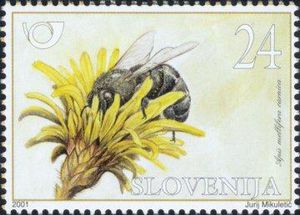
Global pollinators, like honeybees, are declining in abundance and diversity, which can adversely affect natural ecosystems and agriculture. Therefore, we tested the current hypotheses describing honeybee losses as a multifactorial syndrome, by investigating integrative effects of an infectious organism and an insecticide on honeybee health. We demonstrated that the interaction between the microsporidia Nosema and a neonicotinoid (imidacloprid) significantly weakened honeybees. This provides the first evidences that interaction between an infectious organism and a chemical can also threaten pollinators, interactions that are widely used to eliminate insect pests in integrative pest management. An independent American study by Pettis et al. recently confirmed these results.
Global pollinators, like honeybees, are declining in abundance and diversity, which can adversely affect natural ecosystems and agriculture. Therefore, we tested the current hypotheses describing honeybee losses as a multifactorial syndrome, by investigating integrative effects of an infectious organism and an insecticide on honeybee health. We demonstrated that the interaction between the microsporidia Nosema and a neonicotinoid (imidacloprid) significantly weakened honeybees. This provides the first evidences that interaction between an infectious organism and a chemical can also threaten pollinators, interactions that are widely used to eliminate insect pests in integrative pest management. An independent American study by Pettis et al. recently confirmed these results.